
The Decision Before the Decision
A quiet, private commitment made across three ordinary days — before anything is signed, before anyone is told, before it's visible from outside.
Venture in Play — Case 1
A Racine Story
Whether to build the company herself, after the employer best placed to build it says no — with nothing started, nothing signed and nobody told.
Telling the difference between a market that isn't asking for something and a market that doesn't yet know it can.
~14 minutes. No commitment point in this one — three ordinary days, and three places to stop and think.
October. Ten years at Mercer Braun, four of them running sourcing for its naturals portfolio.
Each case contributes to Racine's Lived Business Plan. See what this one added:
Thesis · Producer network · Ask and ownership
6 of 10 sections filled
This case follows Romane Tessier across three days that don't look significant from the outside. She attends a meeting, makes a phone call, takes a train.
It's about the decision before the decision — the private, irrevocable commitment a founder makes before anyone else knows a venture has begun. By the time it's visible from the outside, it has already happened.
As you read, notice what she already knows but hasn't admitted to herself — and the moment it becomes something she can no longer avoid.
Part One — The Verdict
London on a Thursday evening in October does not soften things.
Romane Tessier walked out of the Mercer Braun offices on Southwark Street at half past six and stood for a moment on the pavement, letting the cold settle around her. The city moved with its usual indifference — cyclists threading through taxis, a group of colleagues from some other company spilling out of a pub, the low orange light of a sky that had already given up on the day.
She had been at Mercer Braun for ten years, the last four running sourcing for the naturals portfolio. She knew this street in every season. She also knew what a certificate of analysis was worth, which suppliers had been audited and which had only been asked, and how much of what a label promised was documented anywhere at all.
The meeting with Fiona Marsh had lasted forty minutes. It had been, in most measurable ways, a good meeting. Fiona was precise and fair, as she always was, and she had listened properly — the kind of listening that does not perform itself but simply attends. She had asked two or three questions that showed she had understood what Romane was proposing. She had not dismissed it quickly or carelessly.
Which was, in its own way, the problem.
What Romane had presented was not a formal business case. It was closer to a direction — a set of convictions about where the natural beauty market was failing and what a company with Mercer Braun's infrastructure might do about it. Mercer Braun made things at volume and sold them through other people's shops: four brands, a manufacturing base in the Midlands, shelf space in every chain that mattered. Infrastructure meant reach. It had never meant origin.
She had used the word provenance several times. She had talked about producer relationships, about the gap between the story on the label and the reality behind it, about a consumer who was increasingly educated and increasingly sceptical and who deserved better than a performance of authenticity. She had spoken with the careful precision of someone who had been thinking about this for longer than the meeting suggested.
Fiona had nodded throughout. And then, in the measured way of someone who has held a senior position long enough to deliver clarity without cruelty, she had said: I understand what you're describing, Romane, and I think you're right that there's something there. But this isn't the direction we're heading. We have a model that's working. What you're proposing would pull us away from it rather than build on it. And honestly — and I say this because I respect your thinking — it's not what the market is asking for at scale.
Romane had nodded. She had thanked Fiona for her time. She had walked to the lift and pressed the button for the ground floor and stood very still as the floors descended.
It's not what the market is asking for at scale.
She turned the sentence over now as she walked toward London Bridge, hands in her coat pockets, the Thames coming into view between buildings. She knew what Fiona meant by it. She had spent a decade learning the logic of that sentence from the inside. Markets don't ask for things that don't yet exist in legible form. Demand is not discovered. It is shaped. The brands that built the organic food movement were not responding to a market request — they were making one. The same was true of natural wine, of specialty coffee, of the small and stubborn contingent of beauty producers in southern Europe who were doing something real with what they grew, without anyone in a northern European city knowing their names.
The question was not whether the market was asking for it. The question was who would do the shaping, and when, and whether by the time the answer was obvious it would be too late to be the one who did.
She bought a coffee she didn't need from a place near the station and stood outside with it, watching the river. She did not call anyone. There was no one she wanted to perform composure for, and no one she wanted to perform collapse for either. She was neither composed nor collapsed. She was, if she was honest with herself, very clear.
She had run the numbers a year ago. Not as a plan — as the kind of arithmetic you do at two in the morning and then close the laptop and go back to bed. What a decade of London had left her, minus what London took to live in. She had given herself eighteen months. She had never told anyone she had worked it out, which was itself the tell.

She had been waiting, without knowing she was waiting, for something to stop being possible. The proposal to Fiona was the last version of the question she had been asking inside Mercer Braun for three years: is there a way to do what I think should be done, here, with these people, within this structure? The answer, delivered with genuine kindness by a woman she respected, was no.
That was useful. Unhappy, but useful.
She finished the coffee and walked to the station and caught the train home.
Fiona Marsh's verdict was not unkind. It was accurate — accurate to what Mercer Braun is, what it is built to do, and what the market currently rewards at scale. And yet Romane leaves the meeting more certain rather than less.
Think about a time when institutional feedback pushed against something you believed. What did you do with that verdict — take it as instruction, or take it as information? And is there a difference between a market not yet asking for something and a market not yet knowing it can?
Part Two — The Call
Ten days passed. Romane worked. She sat in meetings and contributed and did the job with the competence that had become, over the years, so reliable it was almost invisible. No one who watched her in those ten days would have known anything had shifted.
On a Sunday morning, with rain moving slowly across the city outside her kitchen window, she called Kostas Papadimitriou.
She told herself she was calling to catch up. It had been a few months. He was entering the quiet season on the land — late October in the Peloponnese, the olive harvest finishing, the aromatic herbs cut back, the distillery running its last batches of the year before winter. She knew his calendar almost as well as she knew her own.
He had first met Romane when she was twenty-one years old, at a small trade event in Montpellier where she had been selling products sourced from producers like him. He had noticed her because of how she handled a jar of rose floral water — not with the practised gesture of a saleswoman but with the care of someone who understood that the thing in her hands had come from a specific field, in a specific season, tended by a specific person who was not her. That quality of attention, he had thought, was rare.
They talked for a while about his harvest. About the olive oil yield this year — lower than usual, but the quality exceptional, the polyphenol levels among the highest he had recorded. About the last batch of sage essential oil from the hillside above his father's original grove, which had turned out better than expected. He described things with a specificity that Romane found steadying — the difference between the sage from the lower slopes and the upper ones, how the morning mist off the sea affected the harvest window, what it meant for a floral water to be distilled within hours of picking rather than days.
She listened and asked questions and felt, slowly, something in her chest loosen slightly.
Then, without planning it, she said: I think I'm going to do something with what you grow. Properly this time.
There was a pause. Not a surprised pause — more the pause of someone setting down what they were holding in order to give full attention to what had just arrived.
Tell me what properly means to you, Kostas said.
She had not expected the question, which meant she answered it honestly rather than well. She talked about provenance — not as a marketing position but as a structural commitment. About the gap between what his land produced and what reached a consumer in London, and how that gap was filled not with his story but with someone else's approximation of it. About a model in which the producer was a partner rather than a supplier — not unnamed, not interchangeable, not replaceable the moment a cheaper option appeared. About the kind of connection between maker and consumer that the wine world had built over decades and that beauty had never seriously attempted.
She talked for longer than she intended. Kostas listened without interrupting.
When she finished, he asked his second question: What's stopping you right now?
She started to answer with the practical things — capital, risk, the gap between a concept and a business — and then stopped. Those were real, but they weren't the answer. She tried again.
What was stopping her, she said slowly, was that the version of herself that London had built was very good at operating inside structures. She knew how to move within a system, how to find leverage, how to get things done within an organisation that had its own logic and its own gravitational pull. She was not sure she trusted the version of herself that would have to operate without one. Without the structure, without the resources, without the institutional credibility that ten years at Mercer Braun had given her. That version of herself — the one who ran a marketplace out of a student flat in Montpellier with a North Macedonian classmate and a borrowed van — felt both very close and very far away.
Kostas was quiet for a moment.
You always knew what the products should be, he said. You knew it when you were twenty-one. You just need to remember that you also knew how to find them.
It was not advice, exactly. It was a reminder of prior evidence. She had done this before — imperfectly, without resources, without experience — and she had known what she was doing. The knowledge had not gone anywhere. It had just been doing other things for a decade.
They talked for a few more minutes about practical things — timelines, product categories, the question of which producers might be interested in a different kind of relationship with a market they had never been able to reach directly. Kostas had names. Forty years of them: who was curious, who was tired, who would never trust a stranger from London whatever the introduction. I'll make some calls, he said, in the tone of a man describing a small errand. Neither of them said what it was worth. She wrote some of the names down on the back of an envelope and then looked at what she had written and understood that this was no longer a call to catch up.
She got off the phone and sat for a long time at the kitchen table with the rain still moving across the window. The idea was no longer only in her head. It had been spoken aloud to someone who took it seriously. That changed its weight.
Romane's idea had existed in her mind for years — sharpened by a decade of industry experience, but largely interior. Saying it aloud to Kostas — someone who knew both her and the world she was describing — changed something.
Who is the person in your life who would take your idea seriously? Not someone who would encourage it reflexively, but someone whose engagement would make it more real? And what, if anything, is preventing you from saying it to them?
If you can name that person: what would you say to them — in one sentence — if you called them today?
Part Three — Cambridge
She took the train to Cambridge on the last Saturday of October.
Claire Beaumont-Hartley met her at the station in a coat that was slightly too large for her, looking, as she always did, like someone who had more important things to think about than how she looked. They walked into town through streets that were quieter than London in a way Romane always found briefly disorienting — the space, the stone, the sense that the city was not in a hurry.
They had lunch at a place Claire knew near the market, the kind of restaurant that does not need to announce itself. They talked about Claire's students, about a paper she was finishing, about her husband James and the small renovation they had been managing for six months longer than planned. They talked about Romane's mother, who was well, and Romane's brother, who was getting married in the spring in a ceremony that would require Romane to be in Montpellier for four days surrounded by people who would ask her, with genuine warmth, when she was going to do the same.
It was only after lunch, walking along the Backs with the river to their left and the afternoon light going amber through the trees, that they reached the real conversation. This was how it had always worked between them — the other things first, then the thing underneath.
Romane told Claire about the meeting with Fiona. About the call with Kostas. About what she had been carrying since Montpellier, since the early venture with Cveta, since the first time she had stood in a producer's workroom in southern Europe and understood that the distance between what was made there and what reached a consumer in Paris or London was not a natural distance — it was a constructed one, maintained by a supply chain that had no interest in closing it.
Claire listened in the way she had been listening since they were seventeen years old — without rushing toward the useful part, without preparing her response while Romane was still speaking. She had always had that quality. It was rarer than it seemed.
When Romane finished, Claire did not ask whether the idea was viable. She did not ask about the market size or the capital requirements or whether Romane had done a competitive analysis. She was an economist and she would ask those things eventually, and Romane knew it, but that was not what this moment required.
Instead she asked: What happens to you if you don't do this?
Romane had been asked variations of the forward question many times — mostly by herself, in the early morning before the day organised itself around her, in the gap between what she was doing and what she suspected she should be doing. She had not been asked this one.
She looked at the river for a moment.
I keep going, she said. I find the next role. Something that makes sense on paper. I do good work because that's what I do. I get respected for it. She paused. I retire having built things I'm proud of that belonged to other people.
She heard herself say it and something tightened slightly in her chest.
And I think, she said, more slowly, that somewhere in that version of my life, there is a kind of diminishment. That I would carry quietly. And that I would probably not talk about.
Claire nodded. She did not say then you have to do it — which would have been too simple, and both of them knew it. What she said was: I know. I've known for a while.
They walked on. The light was dropping. A cyclist passed them, too fast for the path, and they both stepped aside without breaking the silence.
After a while Claire said: I want to put some money in. Not a lot. Enough to mean it.
Romane looked at her.
I know what I'm doing, Claire said, in the tone she used when she had already run the numbers and was not inviting a discussion of them. I believe in you more than I believe in most things I could put money into. And I want to have a reason to ask you difficult questions at regular intervals. A brief pause. That's not entirely a joke.
Romane felt something that was not quite relief and not quite gratitude — something more complicated, more grounded than either. Claire had known her since before London, since before Mercer Braun, since before the decade of competent and slightly airless professional achievement. She held a version of Romane that the city had not made and could not take away.
They turned back toward the station as the dark came in properly. The streets were lit now, warm in the windows of colleges and restaurants, cold everywhere else.
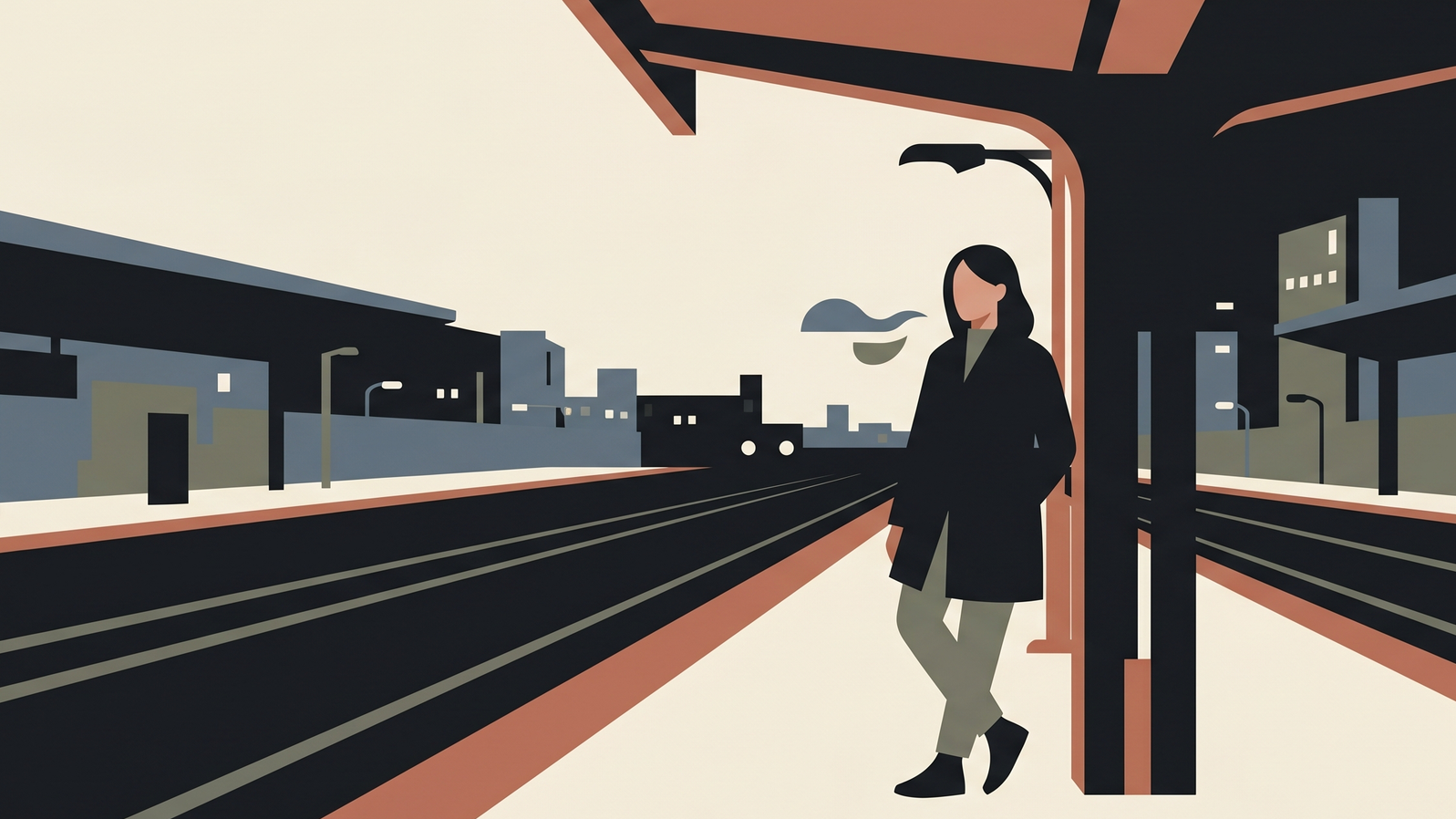
On the platform, waiting for the London train, Romane felt something she recognised from a long time ago — a particular quality of settled. Not excitement, not certainty. More like the feeling of having stopped carrying something at an awkward angle and shifted it to a position where it sat correctly. The weight was the same. The position was better.
She did not know yet what she was building. She did not know the name she would give it, or the first producer she would call after Kostas, or how she would leave Mercer Braun, or what the first version of the business would look like when she could hold it in two hands.
She knew she was building it.
That was the decision. Not announced to anyone, not written down, not visible from the outside in any way that a person watching her board the train could have detected.
The decision before the decision. The one that makes all subsequent decisions possible.
Claire asks Romane the reverse question — not can you build this, but what happens to you if you don't. In the same walk, she also becomes an investor. The moment carries two genuinely different stakes.
The forward question has an answer Romane can rehearse — yes, probably, eventually. The reverse one doesn't. It forces her to describe the version of her life she has never said aloud: competent, respected, and quietly diminished. That's the real stake in this fork — not whether the venture works, but what not trying costs a person over decades.
Claire isn't underwriting a business plan. She's already run the numbers on something else — whether Romane, specifically, is worth backing at this size, and whether money and friendship can sit in the same room without breaking either. The amount is deliberately small: enough to mean it, not enough to control the outcome. What she's really buying is standing to ask hard questions later.
What This Case Is About
The three moments in this case don't look like decisions. The meeting with Fiona ends in a polite no. The call with Kostas ends in notes on an envelope. The walk with Claire ends on a train platform. Nothing is signed, nothing is announced, nothing changes on the outside. And yet by the end of the third scene, something has shifted that cannot easily shift back. That is what the decision before the decision looks like. It rarely announces itself.
The institutional feedback was not wrong. Fiona Marsh's logic was internally coherent. The market, at scale, was not asking for what Romane was proposing. It rarely asks in advance for anything that does not yet exist. That is not a reason not to build them. It is a reason to understand the difference between a market signal and a market possibility — and to know, with some honesty, which one you are responding to.
The phone call with Kostas did something that spreadsheets cannot do. It made the idea real by making it heard. There is a particular kind of progress that only happens when an idea leaves the interior — when it is spoken aloud to someone who takes it seriously and reflects it back with their own attention and their own questions. The idea that comes back is never quite the same as the one that went out. It has been tested by air.
And Claire's question does not appear in most risk assessments. It probably should.
Romane has not failed yet. She has not succeeded yet either. She has decided.
The next case begins with what comes after that.
Before you move on.
Romane's decision wasn't announced. It was felt on a platform, in the dark, as a particular quality of settled.
Name the thing you're circling — the idea, the change, the question you keep returning to. Not the version you'd say in a meeting. The version that's actually true.
Write it down in one sentence. Then ask: is this the decision before the decision, or are you still waiting for permission to make it?
Practise further
Romane measured a decision against what not deciding would cost her. This worksheet runs the same question on your own situation.
The Cost of Not DecidingRead what's next
She's decided. Next she finds out what the market makes of the decision — starting with someone who has no reason to agree with her.
Finding the Ground →See the business plan
This case is where Racine's thesis comes from, and the first producer relationship behind it. Four of ten sections now hold something.
Racine's Lived Business Plan →Venture in Play publishes narrative case studies for founders, leaders, and people with something to build.
The individuals, companies, and events in this case are fictional composites, created for illustrative and educational purposes. Any resemblance to actual persons, businesses, or events is coincidental.