
About Venture in Play
You're about to decide something you can't easily take back — or you're close enough to feel it coming — and nothing in your experience so far tells you whether you're right.
That's the moment these cases put you inside. Not advice about what to think — the decision itself, the way a founder actually meets it, before anyone knows how it turns out.
The cases are fiction. The decisions are not.
A founder has just been told no by someone she respects:
She had been waiting, without knowing she was waiting, for something to stop being possible. The answer, delivered with genuine kindness, was no. That was useful. Unhappy, but useful.
Who this is for
You've built a career but haven't built a company — and you're standing at, or just stepping into, a first decision that will be hard to undo. This is written for you: you bring the experience; the cases give you the rehearsal you can't get any other way yet.
It also reads from the other side of the table. If your work is to judge founders — as an investor, or anyone backing them — the same case shows you what you're actually looking at.
How it works
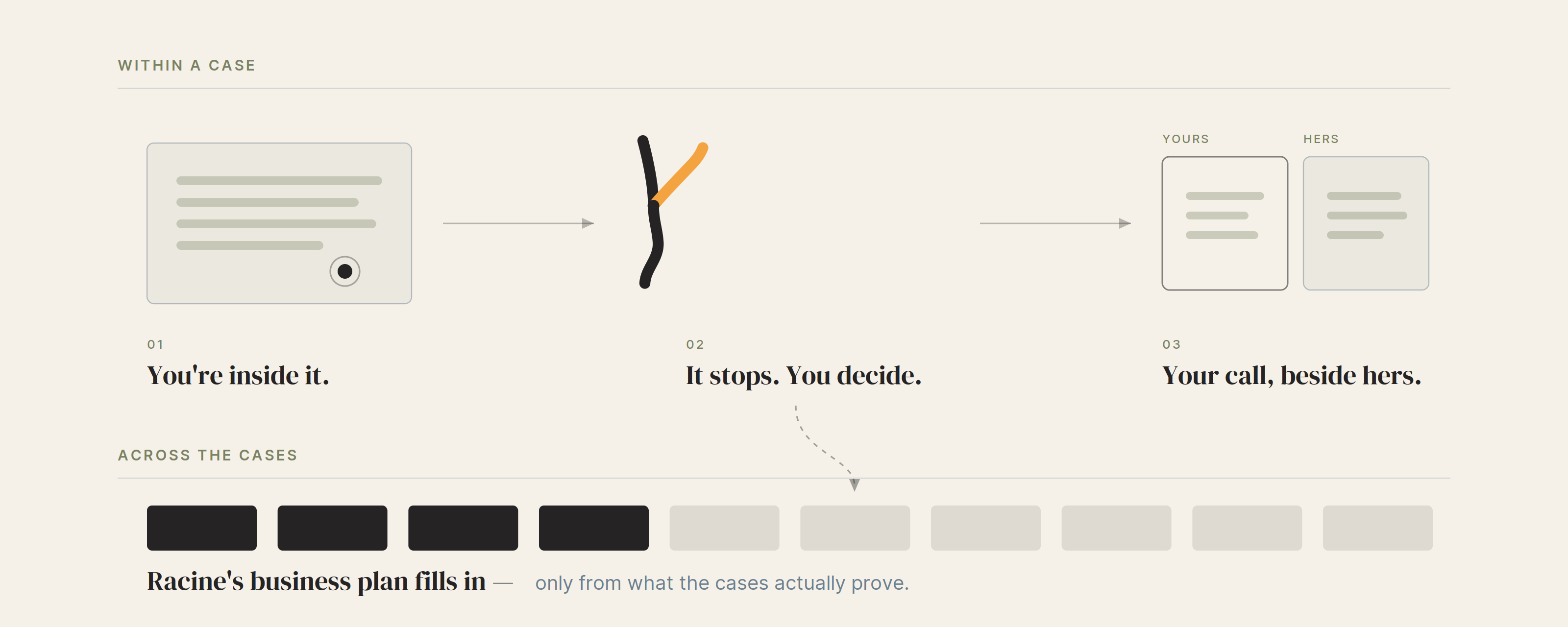
Each case is a narrative — prose, not slides or frameworks. You follow the protagonist into the situation, watch her reason through it, and reach the decision point alongside her. At key moments the case stops and asks what you would do, and why. Then you see what she does, and what it costs.
Cases end at a milestone, not a resolution. Entrepreneurship rarely resolves cleanly. The cases don't either.
The protagonist
Venture in Play runs on paths — a single founder followed through one venture, one decision at a time. The first is The Founder's Journey.
The current path — The Founder's Journey — follows Romane Tessier, a 35-year-old French entrepreneur building Racine, a producer house connecting southern European artisan ingredient suppliers to northern European brands. Romane is not a role model. She makes reasonable decisions under pressure, and some of them don't work out. That's the point. The cases follow her from first idea to the scaling-or-exit decision; the first cases are live now.
The Lived Business Plan
Read along as it's actually being built.
Most business plans are written in advance, from intention. Racine's is written from consequence — it lives inside the case path and fills in only as the cases actually prove something. Ten sections, each accreting from what happens, with what's proven kept honestly apart from what's still open. It isn't a plan shaped to any one reader; it's Racine's own, assembled one real case at a time. You can see its shape and how far it has filled from anywhere on the site. Subscribe to read the sections in full and follow along as each new case adds to it.
What this is not
Not a course, a coaching programme, or a business school — no frameworks, templates, or certificates. It's a publishing platform, and the cases are thinking tools: structured invitations to inhabit a decision rather than watch it from a safe distance.
Behind the platform
Each case is built, not improvised. It starts from a structured layer of real business thinking — the tensions and mechanisms that govern how ventures actually live and die — and is written and edited under close direction, with AI as a research and drafting partner, against a fixed set of editorial standards. The writing is fiction. The decision logic is not.
Venture in Play is created by Vincent van Wylick, out of two long strands of his work: years reading and writing the business plans behind real ventures, and a question he first took up in graduate research — why capable founders and the people who back them so often fail to see each other clearly.
All characters, companies, and situations are fictional composites. Cases are thinking tools, not professional advice.
A challenge you'd like to see explored as a case — or a question about any of it?