
Two Rooms
Masa Madre's second shop opens on a machine André said no to three times. Its customers turn out not to be the first shop's. Then André takes 3 weeks off, his first since the doors opened, to find out whether the bakery can run without him.
The second shop opens on a machine André once refused, and slowly finds its own customers. Then André takes 3 weeks off to see what the bakery can do without him.
Masa Madre, a bakery in Utrecht built on one product, the Volta: a buttery sourdough coil. André bakes with Sanne and Sjef, the apprentice; Wouter runs the money and is about to run a second shop, and Fenna runs the first shop's counter.
Who makes Masa Madre's dough from now on, when each of three ways puts something different at risk: the most loyal customers, the founder's mornings, or more shops.
Judge a product test by who failed it as well as how many passed, measure how many of a new shop's regulars came from the first, and test whether a business runs without its founder by what went wrong, what it cost and who fixed it.
The bank has lent Masa Madre the money for a second shop, and the machine André said no to three times has been running there for 9 days. The shop opens in 2 months, on dough made at André's bench and finished in the machine. Whether the regulars can taste the difference has not been tested.
The second shop sells 70% of what the first one does; the bank planned on 75%. At that rate it loses about €25,000 in its first year after loan repayments, where the bank expected about €9,000. It pays its own way once it sells about a tenth more.
Jump ahead to the decision ↓
After this case, 9 of the 10 sections of Masa Madre's Lived Business Plan have something in them: Who it's for · Value proposition · How it reaches them · Operations · The economic engine · What's proven so far · The team · The ask · What could break it. The thesis is begun.
What each section now says is at the end of the case.
Watch who finds each problem, and who fixes it. The case pauses when André is back and has to decide what Masa Madre's bread will be. You choose before you see what he chose.
Part One
In January, 2 months before Masa Madre's second shop opened, the machine had been running there for 9 days when Wouter asked about it.
It stood against the back wall, a steel cabinet as tall as a man. It was a retarder-proofer. It held shaped dough cold, like the plain retarder at the first shop, but then it also brought the dough up to rise on a program. A panel on the door showed the temperature, the humidity and the hours left. Every morning at 5, Wouter drove 20 of the first shop's shaped Voltas, the coiled loaf the bakery was known for, over in the van's cold box and loaded them into the machine. At 7 he baked them in the new oven and broke one open to see the inside.
In the afternoons, after the first shop's last bake, André came over and taught him the oven: when to load it, for how long, where the hot corner was. On the ninth afternoon Wouter stayed after the lesson.
Can I ask you something? Wouter said. Why did you keep saying no to the machine? We talked about it three times. I never understood.
André looked at the panel. 4 degrees, 82% humidity, empty until 5.
Because bread doesn't work by numbers, he said.
That's still not a reason.
André thought about how to explain it. The spring before last, with Wouter's printout of the financial model on the counter, he had not tried to explain, and Wouter had stopped asking.
All right, he said. Let me try again.
He started from the room.
Every bakery works inside a space. Ours is the room at the back of the shop. It has a temperature and a humidity, and neither is static. In January it's 14 degrees at 4 in the morning and 18 by 10. In a wet week the air is different again. That's a Dutch winter.
Go on.
The dough reacts to that. So at the same time on the clock, the dough can be different from one day to the next. The written method gives you the time. The room decides whether the time is right.
That's what my figures showed the spring before last, Wouter said.
They did. You saw the temperature. I couldn't tell you what it does to the dough.
And you know when the time isn't right.
Yes. He did not try to say how. That's the part I can't give Sanne yet. Sanne was the bakery's other baker.
He put his hand flat on the machine's door.
This controls some of it. Not the first rise. That still happens at our shop, in the tub, in that room's air. But after shaping, it holds the dough where I tell it to: the temperature and the moisture. It does that better than our room does, every day of the year.
Then why say no?
Because it frightened me. He said it to the panel. If the machine decides the times, a year from now nobody here will know why it decides what it does. I'd just be loading it.
Wouter waited.
I was wrong about what it can do, André said. I want to learn it properly. What it does to a coil if I give it 20 more minutes at the warm end. I don't know yet.
Why didn't you say any of that back then?
I didn't have the words. I've got some of them now.
Wouter switched off the panel light, and they locked up.
Part Two
They ran the proper test on a Saturday in the middle of February, 3 weeks before the second shop opened.
Sanne shaped the test batch on the Friday, all from one dough. Half of it stayed in the first shop's retarder overnight and finished rising in the room, the way André's bread always had. The other half went to the new street in the cold box at 5 in the morning. It rose in the machine, was baked in the new oven and came back in Wouter's car at 8.
Fenna, who ran the counter, had picked the tasters from the customer sheet: the 14 regulars who came most often. That week she asked each of them to come in on the Saturday morning for a tasting. She put two plates on the end of the counter, one marked A and one marked B. A had risen in the room, B in the machine, and she did not tell them which was which. Each tasted both, and she asked which they preferred and whether the two were the same.
11 of the 14 said they were the same, and picked A and B about equally. 3 said they were not, and all 3 preferred A. They were the 3 who came most often of all.
They're both good, one of them said, a piece from each plate in her hands. This one has more to it.
More what? André asked.
She thought about it. More taste. It stays longer.
The other two said much the same: B was milder. None of them could say why.
After closing, with the tasters gone, Wouter did the count. That passes, he said.
Those 3 are the customers I'd least like to lose, André said.
Is it worse?
André broke open the last B on the plate. It was a little tighter inside than his, as it had been in his own trial run in September, before they signed the lease. No, he said. It's different. Most people won't notice.
He did not say the rest. The machine's coil was milder because it rose too evenly, and he did not know yet whether a program could change that.
That evening he drove to the new street and changed the program: 20 minutes longer at the cold end, a slower climb to the warm, to give the dough more time to build its taste. He wrote the old settings and the new ones on the sheet taped to the side of the cabinet.
Before the second shop opened, 14 regulars tasted two unlabelled Voltas. One had risen in the first shop's room, the other in the machine. 11 said they were the same. The 3 who preferred the room's were the customers who came most often. Wouter counted it as a pass. André called the machine's bread different, not worse, and changed its program that evening.
Think of a test you've run on your own product or service. Who decided what would count as a pass, and was that decided before the results came in?
Part Three
The second shop opened on the first Wednesday in March.
Wouter ran it, with two counter staff he had hired in January. The customer sheet ran from the first morning, with the two columns Fenna kept at the first shop: what people asked for that was not there, and who came back.
There was also one loyalty card for both shops, with a free coffee after every 10 visits. Wouter had taken the idea from an ice-cream parlour that had opened a second place the summer before. Every card had a number, and the till recorded which shop it was used in.
We'll see who becomes a regular over there, Wouter said. And whether they're ours or new.
By the end of June they had seen it.
The new street was as busy as Wouter had counted it the September before, but fewer of the people walking past came back. On the card, a regular was anyone who came in once a week or more, and the second shop had far fewer of them than the first. It sold 70% of what the first shop sold, under the 75% the bank had planned on.
The cards given out at the second shop showed who the regulars were: people who lived above the shops, or passed at the same time every morning. The office crowd at lunch, the street's busiest hour, bought once.
Almost none of them were the first shop's customers. Of the 312 cards the first shop had given out, 9 had been used on the new street. The second shop was reaching new people, as it was meant to, and it had to make regulars of them itself.
Footfall isn't customers, Wouter said. He had both sheets side by side on the bench. I knew that last September. Now I can see it.
In May, Bakhuis, a bakery chain that had wanted the same unit, opened its fourth shop, a 5-minute walk from theirs. The new shop sold bread, coffee and pastries from 7 to 7, Monday to Saturday.
On Wouter's sheet the second shop's lunch trade dropped the week Bakhuis opened, and stayed down. At the bottom of the sheet Wouter wrote one line: find out what takes the lunch crowd to Bakhuis.
Part Four
On the first Thursday in September, at the bench before the first load, André told Wouter he was taking 3 weeks off, from the Monday after next.
It would be the first time since the doors opened, 3 years before. He had booked it the night before, without asking anyone. If the bakery could not run without him by now, he wanted to know.
Wouter put down the crate he was carrying. 3 weeks, he said. Who makes the dough?
Sanne. She's done the first rise with me every week for a year.
For both shops?
For both shops.
They talked it through after closing, the four of them at the bench: André, Wouter, Sanne and the apprentice. Wouter had a pad in front of him.
The apprentice was 28 months in. His name was Jeffrey. In his first winter Sanne started calling him Sjef: easier to shout across a bakery, and a joke about chef. It stuck. He was more than halfway to being a baker, and for the last few months he had been useful. His job was to learn the craft beside André, and in the meantime to take enough of the bench that André's days got shorter.
We don't bake less, Wouter said. The second shop is selling 70% of what this one does. If it runs out of Voltas, it sells less and we lose more.
And we don't hire someone for 3 weeks, André said. It would take longer than that to teach them the dough.
Then I'll do more, Sanne said. I'm faster at the bench than you are anyway.
She was. She had been quicker and more accurate at shaping since the week she arrived.
Sjef takes more of the shaping, she said. Wouter does the van and covers the counters. We'll manage.
Sjef looked at André. I can do the second shop's trays.
Then do them, André said, and sat down for the first time since closing. He thought it was going to work. Across the bench, Wouter stopped writing. He looked relieved.
Wouter wrote the rota that evening. Staff rotas were his responsibility. He kept Sanne inside the rules for night work: no shift over 10 hours, except up to 5 shifts of 12 in any 2 weeks, and every extra hour given back in November. He pinned it above the sink.
André read it on his way out and did not change anything. He told Wouter and Sanne to ring him if anything went wrong.
André booked 3 weeks off without asking anyone, his first since the doors opened. Sanne offered to take the bench, Sjef the second shop's trays, Wouter the van and the counters. Wouter wrote a rota that kept Sanne inside the rules for night work. André read it and changed nothing.
If you left your own business for 3 weeks from the Monday after next, what would you expect to go wrong first? How would you hear about it?
Part Five
Wouter's message came at 9 in the evening on the Thursday of André's first week away.
Second shop opened without Voltas this morning. Sorted now. Sanne found it. Ring when you can.
There was a photo with it: two trays of coils, wide and flat, spread at the edges.
André rang Wouter first.
The trays had come out of the machine at 7 like that. Wouter had put a sign on the counter and sold everything else. Sanne had mixed a new dough as soon as Wouter rang, warmer than usual so it would rise faster. She shaped it at 11, and Sjef drove it over. The machine brought it up on a short program, and the first Voltas reached the new counter at 2.
About 42 Voltas we didn't sell, Wouter said. With the batch we threw away, about €263.
And the cause?
Ask her. She found it, not me.
He rang Sanne.
She told him what she had seen. The day before had been warm for September, and the room was at 21 degrees by the time she shaped. She had shaped the first shop's trays first and the second shop's last, the way they always did. The second shop's trays had sat on the bench 40 minutes longer before they went cold. They went into the first shop's retarder already further along than the machine's program allowed for. When the machine brought them up the next morning, it took them past the point where they could hold.
So I've changed it, she said. The second shop's trays get shaped first now, and go straight into the retarder. And I take the dough's temperature before it goes in. If it's high, it gets less time in the machine. It's on the sheet.
He thought about how to explain why it had happened.
That's the room, he said. 40 minutes on the bench is nothing in January. In a warm room in September, it's too long.
I know. You've been teaching me and Sjef that for a year. In the summer you always caught it before I did.
He started on the next part: how the dough should feel in the hand before it goes to the second shop. It should be… he said, and could not finish.
Tighter, Sanne said. Than for here.
Tighter. Yes. Not only that.
Then I'll write down how it feels each morning, and we'll go through it when you're back.
He wanted to ask her for a photo of the next morning's trays. He asked what she wanted from him instead.
Nothing this week. Ring on Monday and ask me what I changed.
Wouter rang back an hour later.
Can Sanne carry two more weeks of this? he asked. If not, I can try to borrow a baker for the mornings, or we bake less for the second shop.
André thought about both.
She can, he said. She found it, and she fixed it before anyone asked her to.
Part Six
On the Monday he rang Sanne, and she told him both changes were holding.
In the second week, nobody rang him with a question.
Wouter sent a message every evening: what each shop had sold, what had run out, what the card showed. He moved one of the new counter staff to the first shop for two days when Fenna was ill. By the end of the second week Sanne had worked 4 of the 5 twelve-hour shifts the rules allowed her.
On the Sunday of that week, Wouter rang. It was not to ask anything.
She runs that machine better than you, he said. He sounded lighter than he had in a year. She's changed the program twice this week and written down why each time. I haven't had to ask her anything either.
André laughed. It was the first time in 3 years that something at Masa Madre had gone better without him. He was not sure yet what he thought about that.
André came back on a Wednesday in October.
He did not go to the bench. He went to the counter at 7, when the first load came out, and took a Volta from the tray like anyone else. Then he drove to the new street, waited for the second shop to open, bought one at its counter and drove back.
He put the two on the first shop's counter, side by side, and broke them open.
The first shop's, which Sanne had made to the method as written down, with her two changes, was closer to his than he had expected. The ridge stood. The inside was the one he made, or near enough that he looked twice. He was proud of her, and under that was something he did not look at too closely.
The machine's Volta had changed since he adjusted the program in February, but not by much. It was still a little lower at the ridge and a little tighter inside. Consistent, and not his. He minded that less than he had in February.
The second shop's customers had never had the Volta he made by hand. They had had the machine's every day since March, and for them it was the Volta. By the loyalty card, 11 people had bought at both shops since the opening. They were the only ones who could have told the two apart.
Fenna looked over from the till at the two halves.
Which one's yours? she asked.
Neither, André said. He ate the rest of the first shop's half standing at the counter.
Part Seven
They sat down on the bakery's next day off.
3 weeks, Wouter said. Both shops opened every day. One bad morning, and it was fixed by the afternoon.
So the bakery can run without me.
The baking can. The bakery can't. Someone still has to decide what the bread should be, and that's you. Wouter thought about it. But if the baking runs without you, we can grow.
André had written his options out the night before, on one of Wouter's sheets. He put it on the bench.
| Written method in both shops | André keeps this shop | As before: André bakes for both | |
|---|---|---|---|
| Who makes the dough | Sanne, for both shops | André here, Sanne for the second shop | André, for both shops |
| Customer impact | Our most loyal customers may notice; not yet tested | None here; the few who buy at both taste two breads | None |
| More shops | Yes, from one central bakery | Yes, with bread made to the written method | No |
The machine was in every column. The second shop's dough had to travel cold and finish rising there, whoever made it.
Wouter read it twice. None of these changes what the second shop sells, he said. This year it loses about €25,000, where the bank expected about €9,000, and this shop covers the difference. It stops losing money when it sells about a tenth more than it does now. That takes customers, not a different bread.
So the bread only decides what else we put at risk, André said.
Yes.
André looked at the sheet. Whichever I pick, someone pays for it. If we use the written method in both shops, our most loyal customers might. If I keep this shop, I'm at this bench for good. If I bake for both, we never open a third.
It's your call, Wouter said. Under our agreement, what goes out as Masa Madre bread is yours to decide.
I know.
Wouter put the pen down and waited.
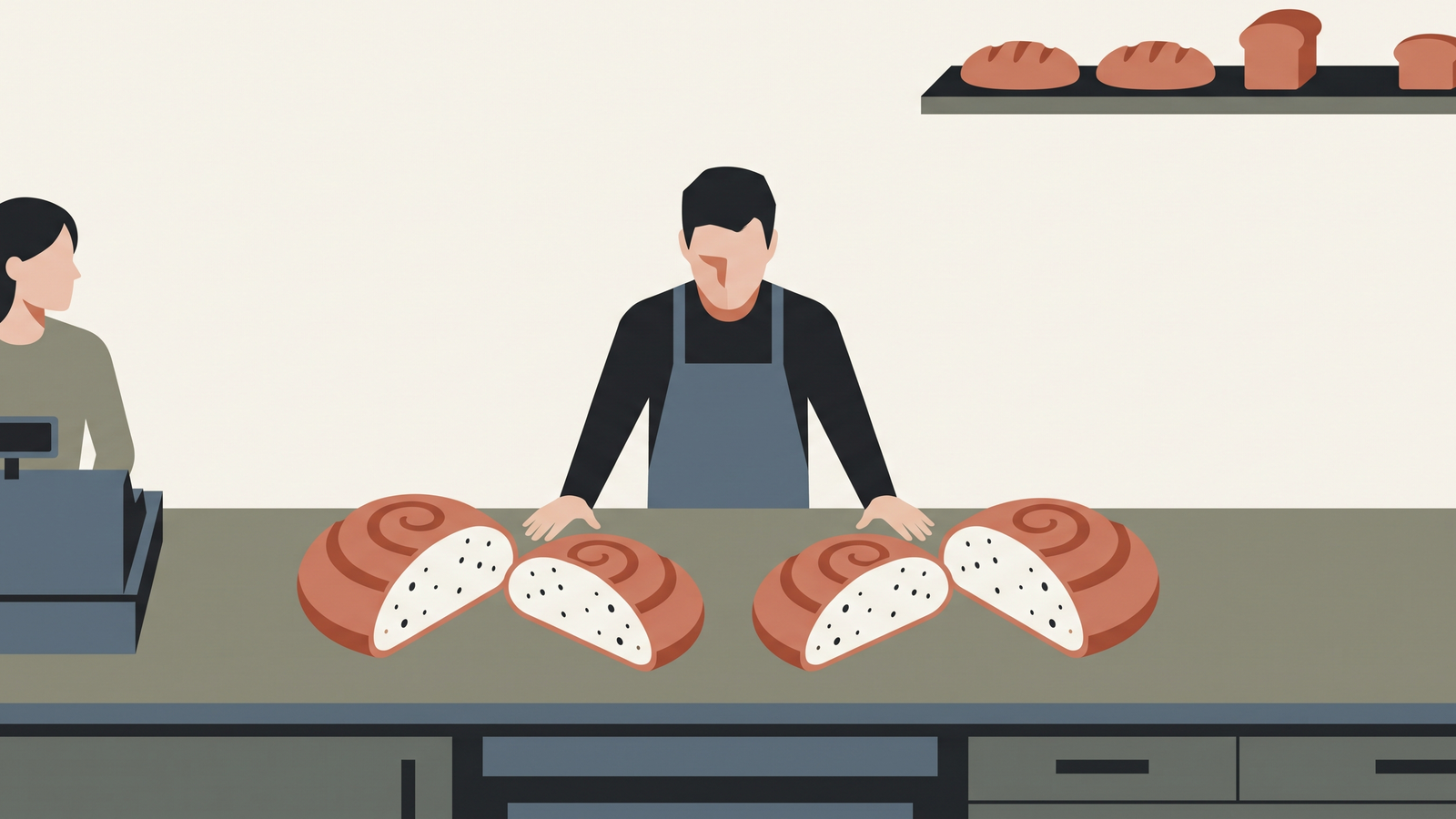
A decision
October, Masa Madre's fourth year. André is back from 3 weeks off, his first since the doors opened. Both shops opened every day. One batch failed, and Sanne found the cause and fixed it the same day. She now runs the machine, and writes down why each time she changes the program.
The first shop's Volta, made by Sanne to the written method, is close to André's own. The machine's is a little lower and a little tighter, and it is the only Volta the second shop's customers know.
What goes out as Masa Madre bread is André's to decide. His sheet sets out three choices. Each puts something different at risk: the most loyal customers, his own mornings, or more shops. The second shop is still losing money. That turns on customers, not bread: it breaks even when it sells about a tenth more.
What should André give up from Masa Madre's bread so the bakery no longer depends on one man, and why?
What's actually on the table
If you chose the written method in both shops, you are betting that its bread keeps the regulars who come most often. February's tasting didn't test that. It compared the first shop's room with the machine, and the 3 who come most often preferred the room. This choice gives the bakery a way to grow, and takes André off the morning bench. It costs the most if those regulars notice.
If you chose to keep this shop, you are betting that a slightly different Volta at each shop won't hurt the Masa Madre name. It keeps the first shop's bread as its regulars know it, and still lets the bakery grow. It costs André the bench for good, in his own words.
If you chose to carry on as before, you are betting that customers come for the bread André makes himself. Nothing changes for any customer. It costs the third shop, and every morning's dough depends on André again, as it did before the 3 weeks off.
Did your reason say who pays for your choice, as well as what it protects?
André keeps this shop, for now. He makes the first shop's dough every morning; Sanne makes the second shop's. He also agreed to a trial at the first shop. On some days its regulars get bread Sanne made to the written method, and the customer sheet shows whether they still come as often.
It costs him what he said it would: he is at the first shop's bench every morning. If the regulars keep coming on trial days, one method can supply every shop. Whether they will isn't known yet.
You chose: Your reason:
André chose to keep making the first shop's dough himself, for now, and a trial that could hand it to Sanne. If the regulars keep coming on trial days, should he stop making it himself?
Coda
From November, the first shop sold bread made to the written method on Thursdays and Fridays instead of André's. They were two of its busiest days, so most regulars would be there. Sanne baked it. The customers were not told, so they would judge the bread, not the news. Fenna added a column to the customer sheet for the day of the week, so they could see whether the regulars came less often on those days.
The second shop ended its first year in February at the loss Wouter had forecast: about €25,000, nearly 3 times what the bank had planned. The first shop covered it.
Over the winter Wouter had found out what took the lunch crowd to Bakhuis: sandwiches made to order, ready in a minute. Masa Madre sold bread, not lunch. So from January the machine held one tray back for a bake at 3, for people on their way home from work. The first shop had once moved its own last bake for the same customers. By March the second shop was selling enough to pay its own way, and it kept doing so through May.
In June, Wouter put a new sheet on the bench: a third shop. There are two ways to do it, he said. One central bakery makes the dough for all three, to the written method. Or this shop keeps your bread, the one our regulars come for, and the others sell bread made to the written method.
The trial decides that, André said.
André read Fenna's column every Monday. It had 30 weeks in it.
November, he said. When it has a year in it, we decide.
The venture in numbers
What the second shop's first year cost, and what 3 weeks without André cost.
| Second shop's sales in its first year, as a share of the first shop's | 70% |
| Share the bank planned on | 75% |
| Second shop after loan repayments, first year | (€25,003) |
| The bank's forecast for that year | (€9,129) |
| Extra sales the second shop needs to pay its own way | about a tenth |
| Second shop's morning without Voltas, lost sales and batch | €263 |
| Tasters before opening who preferred the room-risen Volta | 3 of 14 |
| First-shop cardholders who also used the second shop | 9 of 312 |
From March of the following year, with a 3 pm bake added, the second shop sold enough to pay its own way.
What this case commits the venture to · where the story leaves it
- Already fixed: Both founders personally guarantee the bank loan, and the second shop's lease runs 5 years with no way out before it ends. Under their agreement, what goes out as Masa Madre bread is André's to decide. Every Volta the second shop sells finishes rising in the machine, whoever makes the dough, and the machine's Volta is the only one its customers know.
- Now committed: André makes the first shop's dough every morning, and Sanne makes the second shop's. From November the first shop sells bread made to the written method on Thursdays and Fridays, without telling customers, and Fenna's customer sheet records the day of the week. Sanne's two changes are in the method: the second shop's trays are shaped first, and the dough's temperature is taken before it goes cold. From January a tray is held back for a 3 pm bake at the second shop.
- Still open: Whether the first shop's regulars keep coming on the days Sanne bakes; André decides when the trial has a year in it, in November. Whether a third shop gets its dough from one central bakery, made to the written method, or the first shop keeps André's bread and the others follow the method. So far Sanne is the only baker besides André who knows the method well.
Skipped the story? Read it from Part One ↑
What the plan now knows
After case 4, 9 of the plan's 10 sections have something in them, and The thesis is begun. This case added What could break it, and added to every other section, The thesis included.
- §1 The thesis (begun): one product, the Volta, made from André's own starter. The first shop's trade carried the second shop's loss through its first year.
- §2 Who it's for: the second shop made its own regulars, people who live above the shops or pass at the same time every morning. The lunch crowd bought once. Only 9 of the first shop's 312 cardholders used the second shop. Open: how big each customer group is.
- §3 Value proposition: Bakhuis, a chain, opened a shop a 5-minute walk from the second shop and drew the lunch crowd with sandwiches made to order. Masa Madre kept to bread and added a 3 pm bake for people on their way home.
- §4 How it reaches them: one loyalty card at both shops shows who comes back, and where. The new street was as busy as Wouter had counted, but the people walking past at lunch, its busiest hour, did not become regulars.
- §5 Operations: the second shop's dough is made at the first shop, driven over cold and finished in a retarder-proofer. For 3 weeks Sanne made the dough for both shops. One batch failed on a warm day; she found the cause, fixed it the same day and wrote the fix into the method. Open: how the dough should feel in the hand, which André cannot yet put into words.
- §6 The economic engine: at 70% of the first shop's sales, the second shop lost about €25,000 in its first year after loan repayments, nearly 3 times the bank's forecast. It pays its own way at about a tenth more, and did from the following March.
- §7 What's proven so far: a blind tasting before opening, in which the 3 most frequent of 14 regulars preferred the room-risen Volta. A second shop open since March. 3 weeks without André, with one morning without Voltas at a cost of about €263. A second shop that pays its own way.
- §8 The team: Sanne makes the second shop's dough and runs the machine; Sjef, the apprentice, is 28 months in. Wouter runs the second shop and the rota, Fenna the first shop's counter and the customer sheet. André decides what goes out as Masa Madre bread. Open: Sanne is the only baker besides André who knows the method well.
- §9 The ask: the bank loan, guaranteed by both founders, funded the second shop. In that shop's first year, the first shop covered its loss.
- §10 What could break it (new): three risks. The bread depends on too few people who know the method. The most loyal customers may leave if the bread changes; the trial is testing that. The second shop could lose money for longer than the first can carry; from March it stopped.
Open the full plan. It shows the business where the Masa Madre story leaves it.
What This Case Is About
The previous case, Two Doors, planned Masa Madre's second shop around one limit: André could not yet teach what he does. Every Volta for both shops came from his bakery and his judgement, so if he was away, neither shop had bread. This case takes him away for 3 weeks and finds out what still works.
A test result depends on who was tested. Before opening, 14 regular customers compared André's Volta with the machine's. Most could not tell them apart, and the test passed. The ones who could, a fifth of the tasters, were all among the most frequent customers, the ones who bring in the most money. A pass rate counts every taster equally, but a business does not earn equally from every customer. Before acting on a test, look at who failed it, not only how many.
A second shop has to find its own customers. Masa Madre measured the new shop from its first day, with the customer sheet and one loyalty card for both shops. The card showed two things. People who lived or worked near the new shop in the mornings came back; the lunch crowd did not, because they wanted lunch, which Bakhuis sold and Masa Madre did not. And almost none of the first shop's regulars used the second, so the new shop could not borrow their loyalty. Footfall counts people walking past. Only repeat visits show who becomes a customer.
A system is only tested when the founder is away. André was Masa Madre's head baker and the only judge of its bread. Founders in that position often stay at the bench because the work is good, but then the system around them is never tested. The time off was the test. It failed once: one lost batch, about €263, found and fixed by Sanne the same day, with the fix written down. What counts is who found the cause, and whether the fix held.
Teach people to decide, not only to follow. André had spent months explaining to Sanne why the method works, not just what it is: how the bakery's temperature changes the dough. When the batch failed, she could find the cause and change the process herself, and used André on the phone as a sounding board, not a supervisor. Training that explains the intent lets people make the right call when the founder is not there.
The gate is about the product, not the money. None of the three options changes the second shop's sales, so all three carry the same first-year loss. What differs is the risk each one takes on:
- One written method in both shops: the business can grow from one central bakery, and the most loyal customers may notice.
- André keeps the first shop: nothing changes for its customers, and that shop still depends on him.
- André bakes for both, as before: no customer notices anything, and the business cannot grow past two shops.
The useful questions for a founder in André's position: which decision would he most regret not making himself, can someone else make it to the same standard, and what evidence shows it? Here the evidence is the customer sheet, and the few most loyal customers who could tell the breads apart.
After 4 cases, Masa Madre runs two shops, and the second pays its own way. Its bread no longer depends on one person's hands every morning: the method is written down, and Sanne bakes to it. The next decision is a third shop, which means choosing between one central bakery making one bread for every shop, or keeping the first shop as André's flagship while the other shops follow the written method. The trial will tell them which their most loyal customers accept. The risk that remains is that, so far, Sanne is the only baker who knows the method well, so the next step is training a second baker on it.
Masa Madre’s bread now depends on Sanne as well as André. Fenna's column will show whether the first shop's regulars keep coming on the days Sanne bakes.
Two questions.
First: who in your business is the only person who knows how something important is done? What would it take to have a second?
Second: which of your customers would you least like to lose? Could you name them today, and would you know if they started coming less often?
Read what's next
This is the last Masa Madre case. The bakery runs two shops, a trial is deciding what its bread becomes, and a third shop is on the bench. Subscribe to hear when the next venture starts.
SubscribeSee the business plan
This case adds the second shop's customers and first year, a competitor, how the bakery ran without André, and the risks that could end the business.
Masa Madre's Lived Business Plan →The individuals, companies, and events in this case are fictional composites, created for illustrative and educational purposes. Any resemblance to actual persons, businesses, or events is coincidental.